Britain's adoption problem isn't the AI
How to plug UK PLC into the coming wave

Good morning and happy Wednesday. Today's briefing on AI adoption comes from journalist Alys Key who writes the excellent UK 2.0 newsletter. Enjoy!
Necessity is the mother of invention
Sky-high energy costs, little compute and a lack of funding — the UK doesn’t have the ingredients to develop its own LLMs right now, but London startup Locai Labs has found an ingenious way to repurpose the best open source models into a UK sovereign LLM. Meet GB1 — it doesn’t train on your conversations, uses licensed data, and is powered by renewable energy. UK fusion pioneers First Light are among the organisations already using it and there’s much more to come.
News In Brief 🩳
In Cambridge: The three-day Cambridge Disinformation Summit begins today, with speakers including Imran Ahmed, from the Center for Countering Digital Hate, Labour MP Anneliese Dodds and Professor Gina Neff.
New wheels: The Institute for Driverless Transport launches tomorrow to help prepare policymakers for robotaxis coming to London later this year. The launch event will host four workshops on productivity, social impact, job displacement and security.
Russian hack: Russian military hackers have compromised commonly-used UK routers allowing them to reroute internet traffic through malicious servers, the National Cyber Security Centre warned Tuesday.
Ideas please: Parliament is seeking views on digital sovereignty and how it applies to the UK. It will publish research this summer. You have until April 30 to respond.
Cyber push: Anthropic announced a new model called Claude Mythos Preview would be made available to around 40 organisations to test their software for security vulnerabilities.
Britain's adoption problem isn't the AI
For all the hoopla around the transformational power of AI, British businesses are yet to wholeheartedly embrace it. Research commissioned by DSIT found that just one in six UK firms have adopted AI, causing a headache for the department and wider government as it bets on AI-driven productivity growth.
Not just us: The challenge is global, with Britain’s adoption rate only a little behind that of businesses in the US, where the Census Bureau estimated AI uptake of 17.5 percent. But usage can also be slippery to pin down depending on the metric used. Another survey suggests that 36 percent of British workers are using generative AI for their job, behind the US but on a par with other European countries.
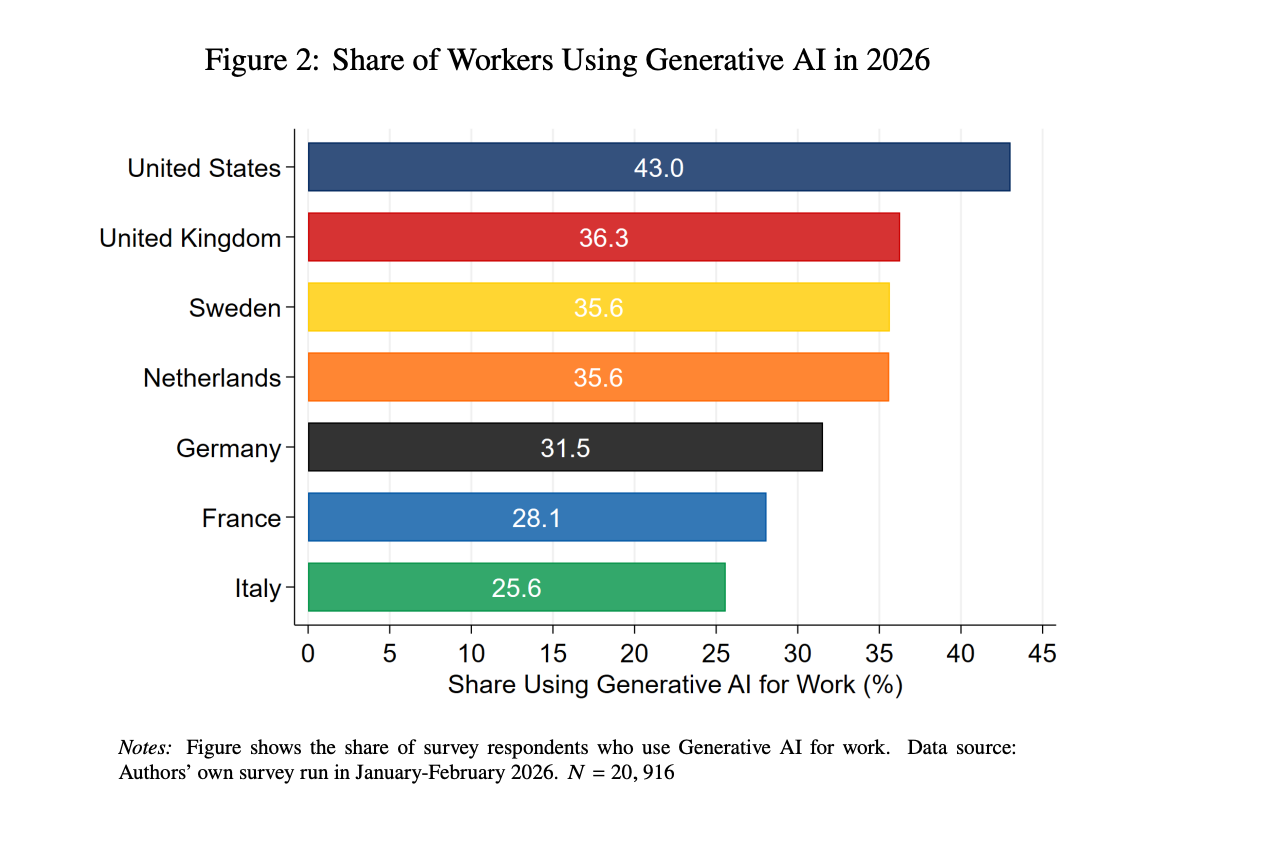
Happy at home, cautious at work: The figure for those using AI at home is much higher at 73 percent, compared to around a third at work, according to a separate government study. That suggests the adoption challenge is in the workplace, rather than with the technology itself. “Often within a company, they're used to quite a top-down approach to policies and direction,” said Bob De Caux, chief AI officer at industrial software provider IFS. This then exacerbates a gap between those who are comfortable using AI in their work and their colleagues who aren’t.
Rules please: A case study published by the CIPD, the professional body for HR, in partnership with the Institute for the Future of Work, suggests one solution is more rules. Conducted as part of the BridgeAI programme, the research details how a construction company increased workers' confidence with AI. It found that training on general-purpose tools wasn’t enough — staff needed to feel comfortable trying new things on their own. A key part of that was setting guardrails so that no confidential data was leaked and they could experiment without fear.
Bye-bye generic: Another issue holding back companies is generic solutions. “The big problem is that they try stuff out-of-the-box and it doesn't do what they want,” De Caux said. “That creates a negative experience, so they're disinclined to continue using it further.” The DSIT survey showed this is how most companies approach AI adoption, with 71 percent buying ready-to-use external software, compared to 14 percent who developed it in-house.
Things move fast: Even if off-the-shelf products seem like the best solution, it can also be hard to keep up with what’s available.
“I think procurement is a big factor, because the space is moving so fast that it's very hard to wed yourself to one or two tools,” observed De Caux.
Money too? There was a tentative suggestion in the government's SME Digital Adoption Taskforce recommendations last year that there should be a review of financial incentives to get SMEs adopting. The Government is due to publish an update on progress in the "spring", minister Blair McDougall confirmed last month.
Head-scratching: But perhaps the most important blocker is that many firms still cannot identify where AI would be useful. Helping different sectors to solve that would unlock the most potential benefit, De Caux argued. “When you've got these tools that can supposedly do everything, where do you start?” This is the goal of the BridgeAI programme, though it only focuses on a specific set of industries.
Over to you, boss: The question is whether government needs to intervene further to get laggards on board with the tech, or whether this problem will be solved by the private sector as more AI products come to market that are tailored to specific business challenges. Ex-prime minister Rishi Sunak argues that it is for the CEOs of SMEs to take the lead.
The agents cometh: But even if more businesses can be persuaded to use LLMs and image generators, the proliferation of agentic AI presents a new problem for businesses. It widens the skills gap yet again, and presents fresh governance challenges. “I think from a policy point of view, regulating agents is going to become very interesting, very quickly,” said De Caux. If companies fear they will be held liable for the actions of an agent in the way they might be for those of an employee, that could throw up a whole new barrier – and a whole new headache for ministers. The key is for the government and regulators to get ahead with frameworks for agentic AI rather than just responding each time the next wave hits.
That's your lot, back tomorrow,
Tom