AI = job cuts? Not so fast
The reality is messier.

Good morning, it's Thursday and it's almost time for a break, but first, indulge me by reading this newsletter.
Happening Today 🗓️
Going for Growth (Labs): Lords will quiz DSIT minister Liz Lloyd about how the government plans to regulate for AI Growth Labs at 11am. Conservative peer Chris Holmes will kick things off with his question, followed by a few minutes of debate. I reported on Tuesday that ministers were looking at a wider Regulatory Reform Bill for May's King's Speech which would include AI Growth Labs - testbeds for AI experimentation.
Not happening today: The Competition and Markets Authority won't publish its decision on the Microsoft and AWS cloud investigation until next week.
News In Brief 🩳
Not bad for breakfast: AI meeting notes app Granola is London's latest "unicorn", after it announced a Series C raise of $125 million, valuing it at $1.5 billion. The round was led by Index Ventures.
Brain fry: The Science, Innovation and Technology Committee has opened an inquiry into how digital devices affect the brain development of children and adolescents. Respond to their call for evidence by April 19.
Another day: A jury in Los Angeles has found Meta and YouTube deliberately designed addictive products that hooked a young user and led to her being harmed, in a landmark US case.
Tech Town Update: Barnsley Hospital will trial AI tools to cut waiting lists, while the government is also giving the area £800k for AI skills courses as part of making Barnsley the UK's first "Tech Town".
What's my age again? Apple is bringing in age checks for iPhone users for the first time in the UK with its latest software update.
AI equals job cuts? Not so fast
Tech CEOs have spent the past year predicting an AI job apocalypse. Their own data tells a more awkward story.
The blood-bath that wasn't: Take Anthropic, whose CEO Dario Amodei believes AI will replace half of all white collar entry roles by 2030. The company’s latest research shows there has been no increase since 2022 in unemployment in job sectors deemed "highly exposed" to AI. Yes, the hiring of younger workers has slowed, but in the UK this cannot just be put at AI's door. Government policies have made it far more expensive to take on new staff.
Claude, do my essay: Anthropic's UK data shows the most frequent use of its Claude chatbot is for students to draft essays and people writing work emails. That doesn't suggest the start of a job apocalypse.
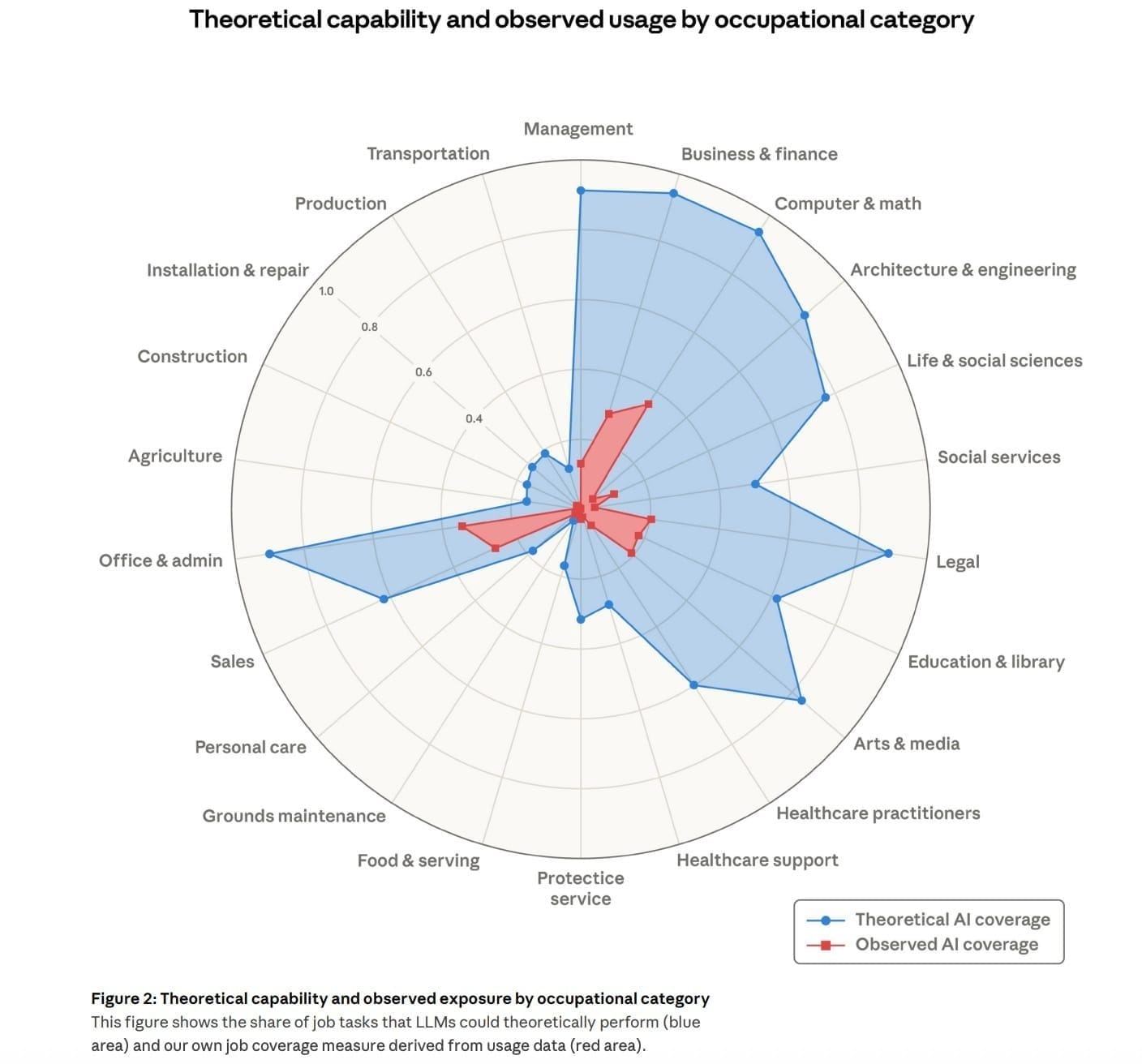
The chart everyone's bookmarked: AI models also have a very long way to go to meet the coverage of tasks Anthropic theoretically thinks they can do. The blue in the chart below is how much of a job category's tasks AI could theoretically be used for vs. the red — what it is actually being used for.
It suggests AI will remain irrelevant for many people's jobs, while in white collar work we're at the start of augmentation rather than replacement.
Task ≠ job: The famous example is radiologists. Demand for them is growing, despite AI being able to automate many of their tasks. The “Jevons' Paradox” here is that as AI makes image analysis faster and cheaper, the demand for imaging has increased.
Messy is good: That’s why I don’t feel panic when looking at the above chart. As LSE professor Luis Garicano says, jobs are messy. Exposure to tasks in the above chart doesn't mean AI will do your job because a task doesn’t equal a job. My view is that if your job isn’t messy then you should look for another one, not because of AI, but because it’s probably boring.
Nice excuse: Companies pinning job cuts to AI’s door also have plenty of other reasons to lay off staff. The latest, Meta, has sunk $80 billion into its Metaverse project, while work in its AI division isn’t going to plan either. Block, which cut 4,000 jobs last month “because AI” has been hit by the slump in crypto prices. This Bloomberg piece picks up nicely on the ‘AI-washing’ of job cuts.
Back me up here academics: Bleak news headlines push the narrative that AI will make much work redundant, but what does academic research show? Cosmo Santoni, a PhD student in Machine Learning at Imperial, has built a market intelligence tool called HiddenState which tracks ML research and flags major trends each day. This is what his data shows:
"We are at the 'how can AI reliably complete a job' stage, not the 'replace 40% of your workforce' stage. The AI narrative from CEOs is obfuscating the truth in a lot of these headlines. I think it helps to think of it like F1. The cars got faster but they didn't replace the driver, they just raised the bar for what's expected from a driver/team."
More work needed: At the end of January the UK government published a little-noticed assessment of AI’s impact on UK jobs. It found job postings fell across the economy but fell faster in high-exposure occupations. In other words hirings has slowed but AI is not causing layoffs. Its main conclusion was that more research was needed.
Early doors: Ministers' thinking on this also seems to be at an early stage, judging by their vague statements. AI minister Kanishka Narayan said last month the government was "planning against a range of plausible outcomes", while tech secretary Liz Kendall told the Lords this month the best defence against AI-labour market changes was to adopt AI.
Don't do it: There will be lots more on this in the coming months as the government's "AI Economics Institute" and "Future of Work Unit" get going. Kendall is also giving a speech about this on May 18 at the Institute for the Future of Work, but don't quit your job and retrain as a plasterer just yet, unless you want to get really messy of course.
Spotted Elsewhere 👀
A weekly round-up of interesting stuff I've read.
Want it, can't get it: My ex-colleague Mark Scott has teamed up with YouGov to poll European attitudes to "digital sovereignty". The takeaway is most Europeans want it, but few believe weaning off US tech is possible.
Green data: Martha Dacombe has another excellent piece, this time on data centres and the politics of scarcity. She argues the left can't have its cake and eat it, opposing UK data centres on environmental grounds, while also wanting less dependence on the US.
Sign me up: China is going all in on OPCs (that's one person companies run with AI) offering them free office space, compute and loans, Rest of the World reports.
Thanks for reading, back tomorrow,
Tom